Abandoned ships and the responsibilities of ownership under Korean law
Abandoned ships threaten navigation and the marine environment, yet their removal is constrained by fragmented regulation, ownership and security rights, and limited public funds. This article examines the Korean legal framework, the limits of preventive intervention and administrative vicarious execution, and why the responsibility attached to ship ownership remains with owners even when public authorities cannot act promptly or effectively.
This blog post is an English translation of a Korean-language column the author contributed to the Korea Shipping Gazette on 1 December 2025. The translation is the author’s own; in the event of any discrepancy, the Korean original prevails.
Abandoned ships along the coast
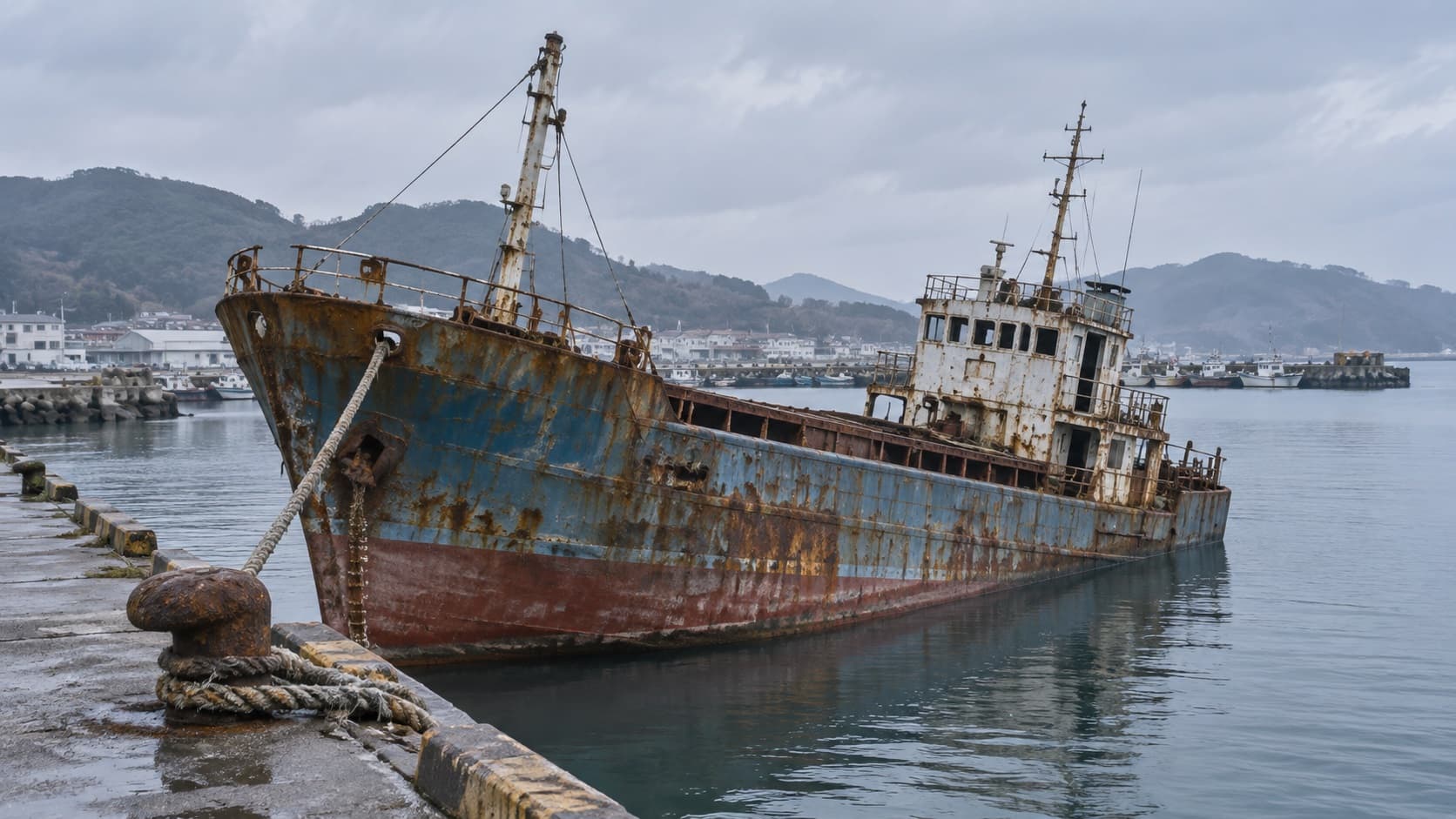
In quiet harbours and along secluded stretches of coastline, rusting ships can be seen listing and half submerged. These abandoned vessels are obstacles that threaten navigational safety and environmental hazards from which oil may leak at any time. As at August 2024, the Korea Coast Guard had identified approximately 376 ships nationwide that had been abandoned or left moored for long periods, and approximately 36 marine pollution incidents involving such vessels had occurred since 2019.
How Korean law defines abandoned ships
Under the existing legal framework, the definition of an abandoned ship derives from a Ministry of Oceans and Fisheries notice, rather than from statute. Under the Regulations on the Handling of Affairs Relating to the Management and Reclamation of Public Waters, the definition covers ships that have not operated for more than one year after the expiry of the period stated in a lay-up declaration; ships that remain moored after compensation has been paid for the closure of the business; and ships that have not been dismantled after their registration has been cancelled. It also covers other ships that the public waters management authority considers may impede the protection and efficient use of public waters or cause pollution.
Fragmented regulation and inspection exemptions
One reason why the problem of abandoned ships has proved so difficult to resolve is that the rules governing them are dispersed across several statutes. The relevant provisions are scattered between the Public Waters Management and Reclamation Act and the Act on the Arrival and Departure of Ships, making systematic and consistent enforcement by the competent authorities difficult.
Ship inspection exemptions also provide an opportunity for ships to be abandoned. Under the Ship Safety Act, a ship is exempt from inspection where its ship inspection certificate has been surrendered and it has been laid up. The Fishing Vessels Act contains a provision to the same effect.
These exemptions were originally intended to ease shipowners’ financial burden during periods when fishing or commercial operations were suspended. In practice, however, there are frequent instances of misuse by some owners who seek to avoid the cost of scrapping their vessels: they maintain lay-up declarations as a formality while effectively abandoning their ships.
The limits of preventive intervention
Where oil has leaked from an abandoned ship, or there is a risk of an oil spill, the Marine Environment Management Act imposes on the shipowner a duty to take pollution response measures or measures to prevent a discharge. In legal terms, however, for a situation to qualify as one in which there is a risk of pollutants being discharged, an accident involving the ship, such as grounding, collision, sinking or fire, must have occurred. Before such an accident, it is therefore difficult to apply those duties pre-emptively to a ship that has merely been left abandoned.
For a public waters management authority to forcibly remove an abandoned ship or take measures to prevent a discharge of pollutants, it must therefore follow the procedure for administrative vicarious execution. That procedure is constrained by the principles of subsidiarity and proportionality. Nor can the requirements for it readily be regarded as satisfied simply because a ship has been abandoned or left moored for a long period.
Property rights and the obstacles to removal
Naturally, a ship does not automatically become the property of the State or a local government merely because it has been abandoned for a long time. In addition, where a mortgage or another security interest has been created over a ship, its hull cannot be disposed of without the secured creditor’s consent under the Public Waters Management and Reclamation Act. Consequently, where a ship retains even some financial value, the complex and interwoven rights of creditors must also be taken into account, and administrative vicarious execution is not infrequently delayed indefinitely or rendered virtually impossible.
Fishing vessels made of fibre-reinforced plastic (FRP) that have no recycling value and are therefore not even mortgaged present another problem. Where an owner deliberately removes the vessel’s name or identifying marks before abandoning it, the owner cannot be identified, leaving no identifiable addressee for an administrative disposition.
In these circumstances, the authorities face a dilemma. If an authority removes an abandoned vessel on its own initiative when its owner cannot even be identified, someone may later appear claiming ownership of that vessel.
Above all, the greatest practical obstacle is funding. Administrative vicarious execution requires an initial outlay from a local or central government budget, yet it is difficult in practice to give priority to allocating substantial funds to the disposal of abandoned ships when the prospects of recovering that expenditure are low.
While the authorities hesitate over budgets and legal procedures, nature does not wait. The typhoons that arrive each summer transform abandoned ships from mere ‘rubbish’ into deadly ‘time bombs’.
Shipowners must bear the underlying responsibility
The essential point to remember is that responsibility for an abandoned ship must rest with the shipowner who left it behind, rather than with the administrative authorities. An owner who has walked away may evade the authorities’ attention for the time being, but will not be able to escape the civil and criminal liability that follows if an accident occurs. An oil spill from an abandoned vessel attracts criminal penalties, while damage to another person’s property caused by an abandoned ship swept away by a typhoon becomes a debt that must be paid in full.
Conclusion
The problem of abandoned ships thus lies at the point where the exercise of private property rights and the responsibilities that accompany them come into sharp conflict with public safety and environmental protection. Various practical limitations and legal barriers prevent the authorities from intervening promptly, but they do not absolve shipowners of responsibility. Ultimately, the central issue is ‘a sense of responsibility for ownership’. It must be remembered that administrative vicarious execution is a measure of last resort in the public interest, supplementary in nature, and never a mechanism for taking over a shipowner’s responsibility.
K. M. Choi is a partner at Law Offices Choi & Kim, qualified in the Republic of Korea, with over ten years in shipping disputes, marine insurance and major casualties in Korean waters. He can be reached at kmchoi@choikim.com or on LinkedIn.
This article describes Korean law and practice in general terms and is not advice on the law of any other jurisdiction. The law is stated as at the date of the original Korean publication and may since have changed, and nothing here creates a lawyer–client relationship.