How two words can waive liability limits in Korean shipping contracts
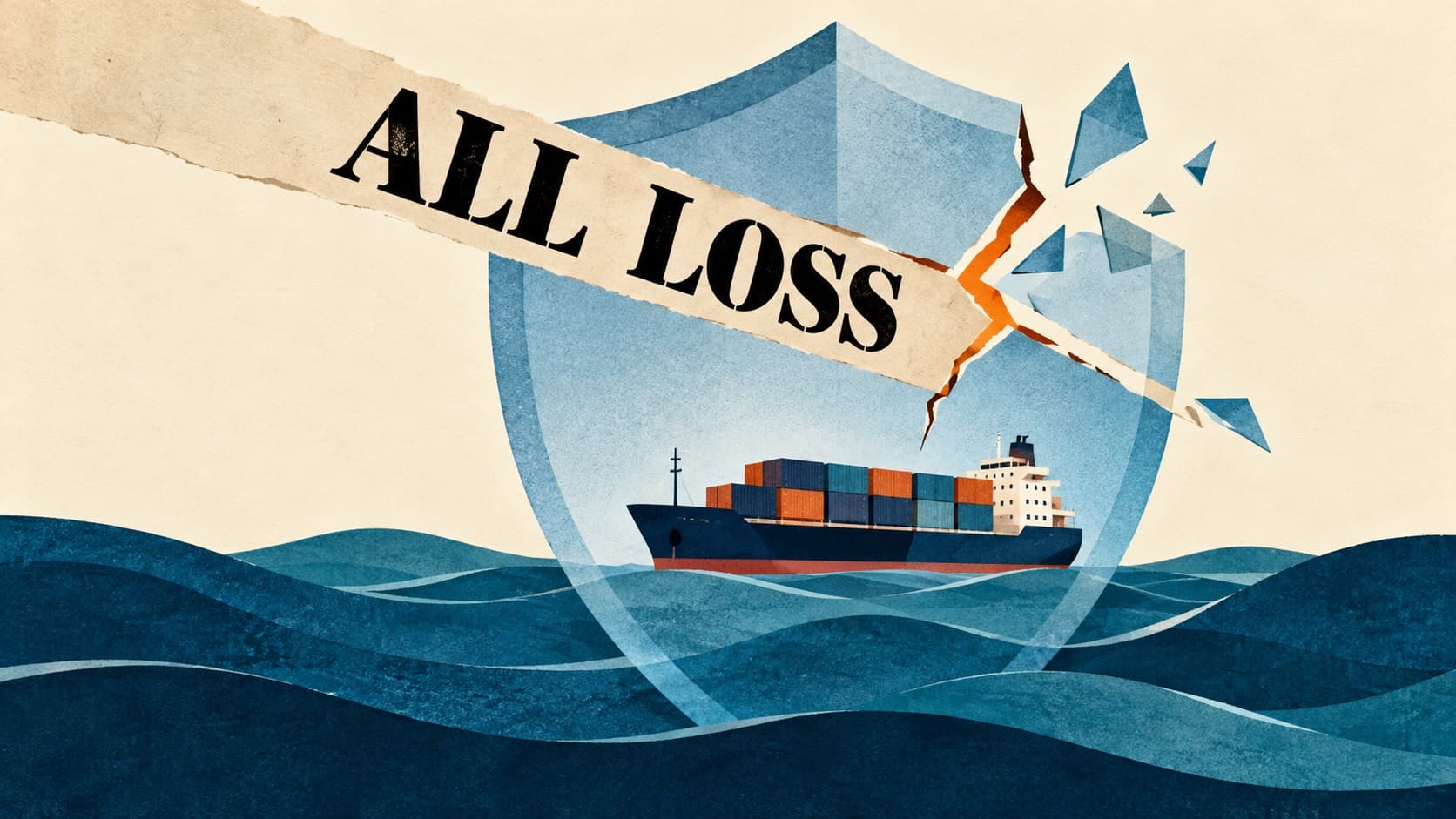
An undertaking to compensate for “all loss” may be construed as waiving a carrier’s right to limit liability under Korean law. A cargo claim illustrates how mismatched contracts can leave a freight forwarder liable to the cargo owner without recourse against the actual carrier. A contract is not only the starting point of a transaction but also the final evidence of where liability rests.
This blog post is an English translation of a Korean-language column the author contributed to the Korea Shipping Gazette on 6 October 2025. The translation is the author’s own; in the event of any discrepancy, the Korean original prevails.
The protection afforded by limitation of liability
Limitation of liability is an essential concept in maritime transport practice. When a maritime casualty or cargo damage occurs, shipowners and sea carriers are, in principle, required to pay compensation only up to a prescribed limit under international conventions or the Korean Commercial Act. This is an established feature of the international shipping system, designed to protect shipowners and sea carriers in recognition of the risks inherent in maritime transport.
When the contracts are not back to back
Yet a single phrase in a contract can render that protection ineffective. Two court cases arising from one cargo damage incident provide a telling example: one before the Seoul Central District Court and the other before the Seoul High Court. The contractual chain linked the cargo owner, a freight forwarder and the actual carrier, but the contract between the cargo owner and the freight forwarder required compensation for all loss, while the terms on the reverse of the bill of lading issued by the actual carrier contained no such wording. The contracts did not follow the back-to-back structure commonly used in practice.
The court interpreted the words “compensate for all loss” as a special agreement by which the freight forwarder waived its right to limit liability, rather than merely as confirmation of its liability. (The court also held that the freight forwarder was a sea carrier in its relationship with the cargo owner.) As a result, the freight forwarder could not rely on limitation of liability in the cargo owner’s damages action and had to pay compensation, although a reduction for contributory negligence was allowed. Its recourse claim against the actual carrier failed on the ground of insufficient packing.
The actual facts were more complex than this account and gave rise to a much wider range of issues. My point, however, is that the two words “all loss”, casually included in the contract by the freight forwarder, brought down the sea carrier’s last line of defence.
Two forms of limitation under Korean law
The Commercial Act recognises two broad forms of limitation of liability for shipowners or sea carriers. One is the regime governing shipowners’ limited liability (global limitation); the other is limitation per package or by weight (package limitation). The Korean Supreme Court has held that the former may be excluded by agreement between the parties, on the basis that the relevant provision of the Commercial Act is non-mandatory.
Although the Supreme Court has not ruled on the latter, the provision governing limitation per package or by weight is also non-mandatory, and special agreements concerning a sea carrier’s liability are valid unless they reduce or exclude the carrier’s obligations or liability. That form of limitation may therefore also be waived by agreement between the parties. Accordingly, the words “compensate for all loss” may be interpreted as a waiver of the right to limit liability.
Different approaches in Korea and England
By contrast, an English court has held that the words “all and any damages” and “harmless” alone were insufficient to establish a waiver of the right to limit liability. It applied a stricter standard than the Korean courts. In Korean practice, however, the position taken by the Korean Supreme Court prevails, and appropriate precautions are therefore necessary.
Preserving protection in shipping contracts
In everyday life, when we cause loss to someone, we often say, “I will take responsibility for all of it.” Such expressions must now be used with care in shipping practice. They may be interpreted as a waiver of a shipowner’s or sea carrier’s rights to limit liability and rely on exemptions from liability. If the intention is to state the obligation in principle to pay damages, a qualification needs to be added, such as one confirming that the Commercial Act’s provisions on limitation of liability and exemptions continue to apply.
Freight forwarders seeking to contract with major cargo owners need to be particularly careful. Given the stronger bargaining position of major cargo owners, an “asymmetrical structure” can readily arise: the freight forwarder waives its rights to limit liability and rely on exemptions in its contract with the cargo owner, while the actual carrier retains those rights under the other contract. It is essential to avoid the situation illustrated above, in which the freight forwarder pays the cargo owner in full but cannot obtain recourse against the actual carrier.
Conversely, cargo owners can use such wording strategically. For the carriage of high-value equipment or project cargo, it may be advantageous to require a clause stating that “the carrier shall compensate in full for all loss incurred”.
The contract as the final evidence determining liability
Once a dispute arises, arguments over the interpretation of contractual provisions and wording are inevitable. It is therefore important to retain material capable of proving the circumstances at the time of contracting and the parties’ intentions, such as email correspondence, meeting minutes and other records. Above all, however, the surest course is to avoid ambiguous wording when the contract is made. Where English and Korean versions of a contract are used together, they must also be compared to check for discrepancies introduced in translation.
Conclusion
The right to limit liability is more than a statutory provision or legal mechanism: it is the sea carrier’s last safety net. Yet a single line in a contract can cause that safety net to fail. The lesson from the case discussed here is clear. A contract is both the starting point for doing business and the final evidence determining where liability ultimately lies. A single phrase casually inserted in a contract to get a transaction moving may result in substantial losses.
K. M. Choi is a partner at Law Offices Choi & Kim, qualified in the Republic of Korea, with over ten years in shipping disputes, marine insurance and major casualties in Korean waters. He can be reached at kmchoi@choikim.com or on LinkedIn.
This article describes Korean law and practice in general terms and is not advice on the law of any other jurisdiction. The law is stated as at the date of the original Korean publication and may since have changed, and nothing here creates a lawyer–client relationship.